
“I enjoy the freedom of just using my hands and “found” tools–a sharp stone, the quill of a feather, thorns. I take the opportunities each day offers: if it is snowing, I work with snow, at leaf-fall it will be with leaves; a blown-over tree becomes a source of twigs and branches. I stop at a place or pick up a material because I feel that there is something to be discovered. Here is where I can learn.”
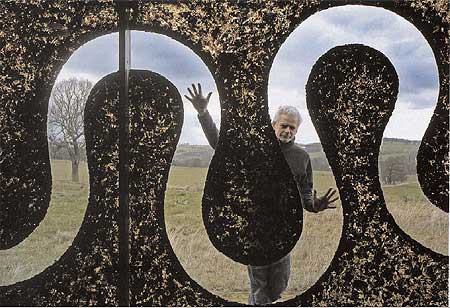
A Yorkshire farm was where, from the age of 13, British artist Andy Goldsworthy first learned his trade: how to use a shovel, skin a hare, build a dry-stone wall. It’s also where he saw a painting in the lines of a plow on the land, a sculpture in a haystack, and where he realized that the idyllic landscape of rural England is one fashioned by sweat and privilege and kept green by death and dung.
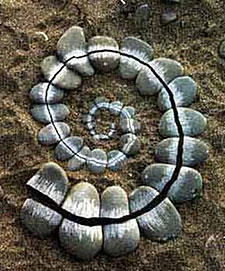 Goldsworthy is a sculptor, photographer and environmentalist living in Scotland who produces site-specific sculpture and land art situated in natural and urban settings. His art involves the use of natural and found objects to create both temporary and permanent sculptures which draw out the character of their environment.
The materials used in Goldsworthy’s art often include brightly-coloured flowers, icicles, leaves, mud, pinecones, snow, stone, twigs, and thorns. He has been quoted as saying, “I think it’s incredibly brave to be working flowers and leaves and petals. But I have to: I can’t edit the materials I work with. My remit is to work with nature as a whole.” Goldsworthy is generally considered the founder of modern rock balancing. For his ephemeral works, Goldsworthy often uses only his bare hands, teeth, and found tools to prepare and arrange the materials.
Photography plays a crucial role in his art due to its often ephemeral and transient state. According to Goldsworthy, “Each work grows, stays, decays – integral parts of a cycle which the photograph shows at its heights, marking the moment when the work is most alive. There is an intensity about a work at its peak that I hope is expressed in the image. Process and decay are implicit.”[
“Movement, change, light, growth and decay are the lifeblood of nature, the energies that I try to tap through my work. I need the shock of touch, the resistance of place, materials and weather, the earth as my source. Nature is in a state of change and that change is the key to understanding. I want my art to be sensitive and alert to changes in material, season and weather. Each work grows, stays, decays. Process and decay are implicit. Transience in my work reflects what I find in nature.”
 Rivers and Tides is a 2001 documentary about the artist, directed by filmmaker Thomas Riedelsheimer. The film received a number of awards, including the San Diego Film Critics Society and the San Francisco Film Critics Circle awards for best documentary. Now with this deeply moving film, shot in four countries and across four seasons, and the first major film he has allowed to be made, the elusive element of time adheres to his sculpture.
The director worked with Goldsworthy for over a year to shoot this film. What he found was a profound sense of breathless discovery and uncertainty in Goldsworthy’s work, in contrast to the stability of conventional sculpture.
There is risk in everything that Goldsworthy does. He takes his fragile work – and it can be as fragile in stone as in ice or twigs – right to the edge of its collapse, a very beautiful balance and a very dramatic edge within the film. The film captures the essential unpredictability of working with rivers and with tides, feels into a sense of liquidity in stone, travels with Goldsworthy underneath the skin of the earth and reveals colour and energy flowing through all things.
Review at Yorkshire Sculpture Park website
Earth Art Exhibit at Royal Botanical Gardens
If you enjoy Andy Goldsworthy’s work, check out Devon-based environmental artist Linda Gordon: The Art of Place and her blog Opening Spaces
For more amazing environmental art, visit the Green Museum and its blog. This is an online museum. They do not have a physical space filled with a bulky art collection. Instead, as an online museum, their strategy for sharing environmental art reflects their values. They have a very small ecological footprint and can display a wide range of art works from around the globe and include directions so you can visit exhibitions and events first-hand. They are like a traditional museum turned inside out. Instead of visiting one big box filled with art they are many tiny boxes (monitors) encouraging visitors to go out to experience art in the context of their communities and ecosystems.
We shall not cease from exploration
And the end of all our exploring
Will be to arrive where we started
And know the place for the first time.
~~ T.S. Eliot, Four Quartets

 redstarcafe.wordpress.com
very perceptive and interesting overview of his work. a great read. thanks,
great art by a great artist
it is great to understand the history of an artist and i am greatfull for the overview of information. but picking out the most controvertial pieces of work was great so you can identify what the ideas of Goldsworthy was.
cheers red star cafe
quality work ….. espetialy that of ice sculptures,
and simplisttic contrast in the leaves.
thanks again
I love the utilization of natural elements.
Certainly one of my favorite Modern Artists.
i do think that he one amasing person. he work is a mirical in its self. i am studying him for my GCSE and he is in the heat of my work at all times. if was not for him would not have taken GCSE art. he is great! THANKYOU Andy!
wow
your art is fantasic we love it !!!!!!!!!!!!
Hey Andy,
We have been learning about you in art at Sittingbourne community college and what we learnt i thought was fntastic! You are a great artist!
Talk to you soon,
From Nia Jacobs x
Pingback: Organic Art (literally) « Innovate!
Andy you are superb and I like the way you make stuff with your hands just like that. One day I want to do something like that!!! You are a wonderful artist.I love your work
I really want to know what’s the meaning of his artworks
I love the art (so pure) and am doing a project for art GCSE on natural forms, cant seem to find the names of any of the pieces? are there names for them if so what are they?
He has very good art work now i feel like doing it myself
Pingback: Leaves | Bethany Hyde
hi
im studying andy for part of my art GCSE and i think his work is really clever and creative ,its very inspiring but i would love to know more about WHY he uses only natural materials and shapes like circles he has alot of pieces with circles and spirals is there a reason for this.
Pingback: Leaves | Bethany Hyde: Art
Pingback: River of Leaves | Bethany Hyde: Art